2026 Nissan Maintenance FAQ: Service Schedules & Expert Care | Empire Nissan
Keeping your 2026 Nissan running at its best starts with understanding the service intervals, inspections, and care practices that protect your vehicle long-term. The team at Empire Nissan in Ontario, CA has put together this FAQ guide to answer the most common questions our service customers ask — covering routine service schedules, multi-point inspections, prepaid maintenance plans, OEM versus aftermarket parts, battery health, and the unique needs of electric vehicles.
For full service details or to book an appointment, visit our Service Center page.
What Should Drivers Know About Maintenance Intervals for 2026 Vehicles?
Maintenance intervals for 2026 Nissan vehicles follow a structured timeline designed to keep your vehicle performing reliably. These intervals are based on extensive testing and real-world conditions, and following them protects both your investment and your warranty coverage.
For most 2026 Nissan models, routine maintenance checks are recommended every 5,000 to 7,500 miles. Oil and filter changes anchor this interval — they remain among the most critical maintenance tasks because regular oil changes maintain engine lubrication, reduce wear, and improve fuel efficiency. This is especially important for drivers in Ontario, CA and surrounding Inland Empire communities where stop-and-go traffic is common. Modern synthetic oils used in many 2026 Nissan engines may extend this interval in some cases, so always consult your owner’s manual or our service team for your specific model.
2026 Nissan Maintenance Quick Reference
| Service Item | Recommended Interval |
|---|---|
| Oil & Filter Change | Every 5,000 – 7,500 miles |
| Coolant, Transmission, Brake & Power Steering Fluids | 30,000 – 60,000 miles (model-dependent) |
| Engine & Cabin Air Filters | Every 15,000 – 30,000 miles |
| Spark Plugs (Iridium) | Inspect at 60,000 mi; replace ~90,000 mi |
| Brake Fluid Replacement | Every 2 years (or per mileage interval) |
| Timing Belt | 60,000 – 100,000 miles (most 2026 Nissans use chains) |
Beyond oil changes, fluids such as coolant, transmission fluid, brake fluid, and power steering fluid have their own intervals — often around 30,000 to 60,000 miles, depending on the fluid and your specific Nissan model. These exchanges prevent corrosion, overheating, and wear on critical systems. Newer Nissan vehicles often use long-life coolant that extends the change interval significantly beyond traditional formulations.
Air filters, cabin filters, and spark plugs are next on the list. Air filters typically require replacement every 15,000 to 30,000 miles depending on driving conditions. Spark plugs in modern 2026 Nissan engines often use long-life iridium designs that extend their service life — most are inspected around 60,000 miles and may not need replacement until 90,000 miles or beyond. These checks help prevent engine misfires, rough idling, and reduced fuel economy.
Brake system maintenance is also a priority. Brake pads, rotors, and fluid should be inspected regularly, and brake fluid replacement is typically recommended every two years or per your model’s mileage interval to maintain braking responsiveness and safety.
Timing belt or chain replacements are scheduled between 60,000 and 100,000 miles for vehicles with timing belts. The good news for most 2026 Nissan owners: nearly all current Nissan engines use timing chains designed to last the life of the vehicle under normal conditions. They still benefit from periodic inspection during scheduled service.
Many 2026 Nissan vehicles also come equipped with onboard maintenance reminder systems that adjust service alerts based on your actual driving conditions rather than fixed intervals. These systems factor in driving style, climate, and engine load to provide a more personalized maintenance schedule — particularly useful across the varied driving environments of Rancho Cucamonga, Montclair, and Fontana.
Following these intervals doesn’t just protect performance — it preserves your warranty coverage. Skipping scheduled services can lead to warranty issues and costly repairs down the road. The factory-trained technicians at Empire Nissan use genuine Nissan parts and the latest diagnostic tools to keep your 2026 Nissan in peak condition.
What Should Drivers Expect During a Comprehensive Multi-Point Inspection?
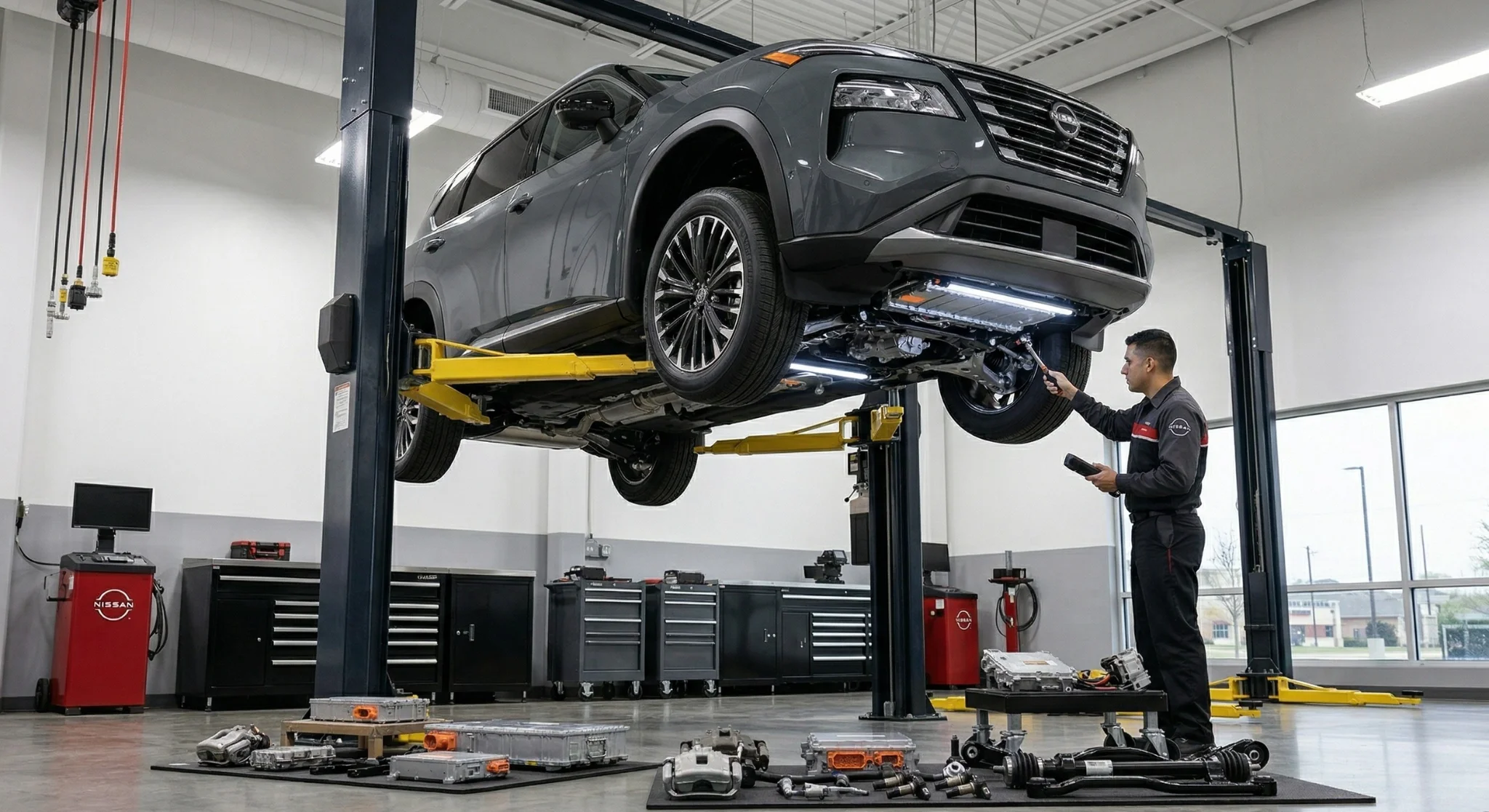
A multi-point inspection is one of the most valuable services you can have performed on your 2026 Nissan. When you bring your vehicle to Empire Nissan, our technicians conduct an extensive evaluation that goes well beyond a casual visual check — identifying potential issues early before they become costly repairs.
A typical multi-point inspection examines the engine, transmission, brakes, tires, suspension, and fluid levels. Technicians check brake pads and rotors for wear, assess tire tread depth and inflation, and inspect suspension components for any signs of damage that could affect handling. Engine oil, coolant, brake fluid, and transmission fluid are all monitored to ensure proper levels and no contamination.
Engine & Transmission
Fluid levels, contamination check, and performance diagnostics
Brakes & Tires
Pad & rotor wear, tread depth, and tire inflation
Safety Systems
Lights, wipers, seat belts, and ADAS sensor function
Battery & Electrical
Battery health, charging system, and electrical diagnostics
Our technicians use specialized diagnostic equipment tailored for Nissan vehicles, allowing them to detect issues that might not be visible during a casual check. This level of detail helps extend your vehicle’s lifespan and maintain reliability whether you’re commuting through Ontario or driving across the Inland Empire.
For owners considering a pre-owned vehicle, a multi-point inspection is especially valuable. It provides a clear picture of the vehicle’s current condition and any maintenance it may require — helpful information when you’re shopping our used Nissan inventory.
Scheduling regular inspections through Empire Nissan’s service center is a proactive way to keep your 2026 Nissan running smoothly.
Are Prepaid Maintenance Plans Worth It for Your New 2026 Vehicle?
For many new 2026 Nissan owners, a prepaid maintenance plan can simplify the ownership experience. These plans bundle the cost of routine services — oil changes, tire rotations, scheduled inspections — into a single upfront payment. The main advantages: locking in maintenance costs at today’s prices and creating financial predictability over the first few years of ownership.
From a practical standpoint, prepaid plans also encourage owners to follow the manufacturer’s recommended service intervals. Because the services are already paid for, drivers tend to bring their vehicles in regularly — which sustains optimal performance and can extend the lifespan of critical components. For Empire Nissan customers in Ontario and across the Inland Empire, prepaid plans ensure all services are performed by Nissan-certified technicians using genuine parts that match the precise specifications of your 2026 model.
That said, it’s important to review what each plan includes. Some packages cover only basic services, while others extend to more comprehensive care like brake inspections or fluid replacements. Comparing offerings against your expected driving habits helps determine the right fit. A driver who frequently encounters stop-and-go traffic might benefit from a plan that includes brake system maintenance, while someone with mostly highway driving might prioritize oil changes and tire rotations.
Resale value is another consideration. If you plan to keep your 2026 Nissan for an extended period, a prepaid plan supports consistent upkeep and adds to the vehicle’s service history — which can enhance resale value. If you anticipate trading in within a few years, ask whether the plan is transferable to the next owner.
To learn which prepaid maintenance options are available for your 2026 Nissan, contact our service team.
Should Ontario Drivers Choose OEM or Aftermarket Parts?
The choice between Original Equipment Manufacturer (OEM) parts and aftermarket parts is a common one for vehicle owners. OEM parts are components produced by Nissan specifically for Nissan vehicles, designed to meet exact specifications. This guarantees compatibility and performance that align precisely with the engineering behind your 2026 Nissan.
Aftermarket parts, by contrast, are made by third-party companies and can vary widely in quality and fit. Some aftermarket parts perform adequately, but others may not meet the rigorous standards set by the manufacturer. This variability can affect not only the longevity of the repair but also your vehicle’s overall performance and safety.
Genuine Nissan OEM Parts
Engineered specifically for your 2026 Nissan with exact-match specifications. Backed by manufacturer warranties, support warranty coverage, and help preserve resale value.
Aftermarket Parts
Lower upfront cost but variable quality and fit. May not meet manufacturer standards, can affect performance and safety, and may lead to more frequent replacements over time.
For critical components like brake pads, suspension parts, or engine components, OEM parts ensure your vehicle maintains its designed handling, safety, and efficiency. Using OEM parts during repairs at Empire Nissan’s Parts Department protects your investment by upholding warranty coverage and preventing potential issues from incompatible components.
OEM parts also typically come with their own manufacturer warranties, providing additional peace of mind about durability and quality. While aftermarket parts may save upfront costs, they can lead to more frequent replacements down the road — potentially increasing your total maintenance expense over time.
For long-term reliability and optimal performance, choosing OEM parts through Empire Nissan’s Parts Department is the most prudent option. Your 2026 Nissan receives components specifically engineered for it, safeguarding your driving experience and investment.
What Are the Early Signs of Battery Failure?
Catching battery problems early can save you from being stranded. One of the most common early indicators of battery trouble is difficulty starting your vehicle. If the engine cranks slower than usual or requires multiple attempts to turn over, it may mean the battery is losing its charge capacity. Dimming headlights or interior lights when the engine is off — or during startup — also signal that the battery’s ability to hold power is weakening.
Watch for corrosion around the battery terminals as well. This buildup interferes with the electrical connection and accelerates battery failure. Strange odors such as a rotten egg smell may indicate the battery is overheating or leaking acid — a serious issue requiring immediate attention.
Battery age is another important factor. Most car batteries last between three and five years depending on usage and climate. If your battery is approaching this range, have it tested during routine maintenance. Detecting these signs early through regular checks at Empire Nissan can prevent unexpected breakdowns and keep your 2026 Nissan running reliably.
How Does EV Maintenance Differ from Gas-Powered Vehicles?
Maintaining an electric vehicle (EV) involves several key differences compared to traditional gasoline-powered cars. The most notable distinction is the reduced number of moving parts in EVs, which translates to fewer routine maintenance tasks. Electric vehicles do not require oil changes, spark plug replacements, or timing belt services — common maintenance items for gas engines. This often means lower overall maintenance costs and fewer service visits.
EVs do have their own unique maintenance needs, however. The battery pack — the heart of the vehicle — requires careful monitoring to ensure longevity and optimal performance. This includes periodic battery health checks and software updates that help manage energy efficiency and charging protocols. EVs also use regenerative braking systems, which reduce wear on traditional brake components but still need regular inspections to maintain safety and function.
Routine care like tire rotations, cabin air filter replacements, and coolant level checks for battery thermal management are still part of EV ownership. These tasks align with traditional vehicle upkeep but are tailored to the EV’s specialized components. Empire Nissan’s technicians are trained specifically in Nissan EV maintenance — including the Nissan LEAF — ensuring your electric vehicle receives expert care throughout its lifespan.
For any maintenance or repair needs on your EV or gas Nissan, call our service team at (909) 740-6715 or visit us in Ontario by getting directions to Empire Nissan.