What Does Nissan “Service Engine Soon” Mean?
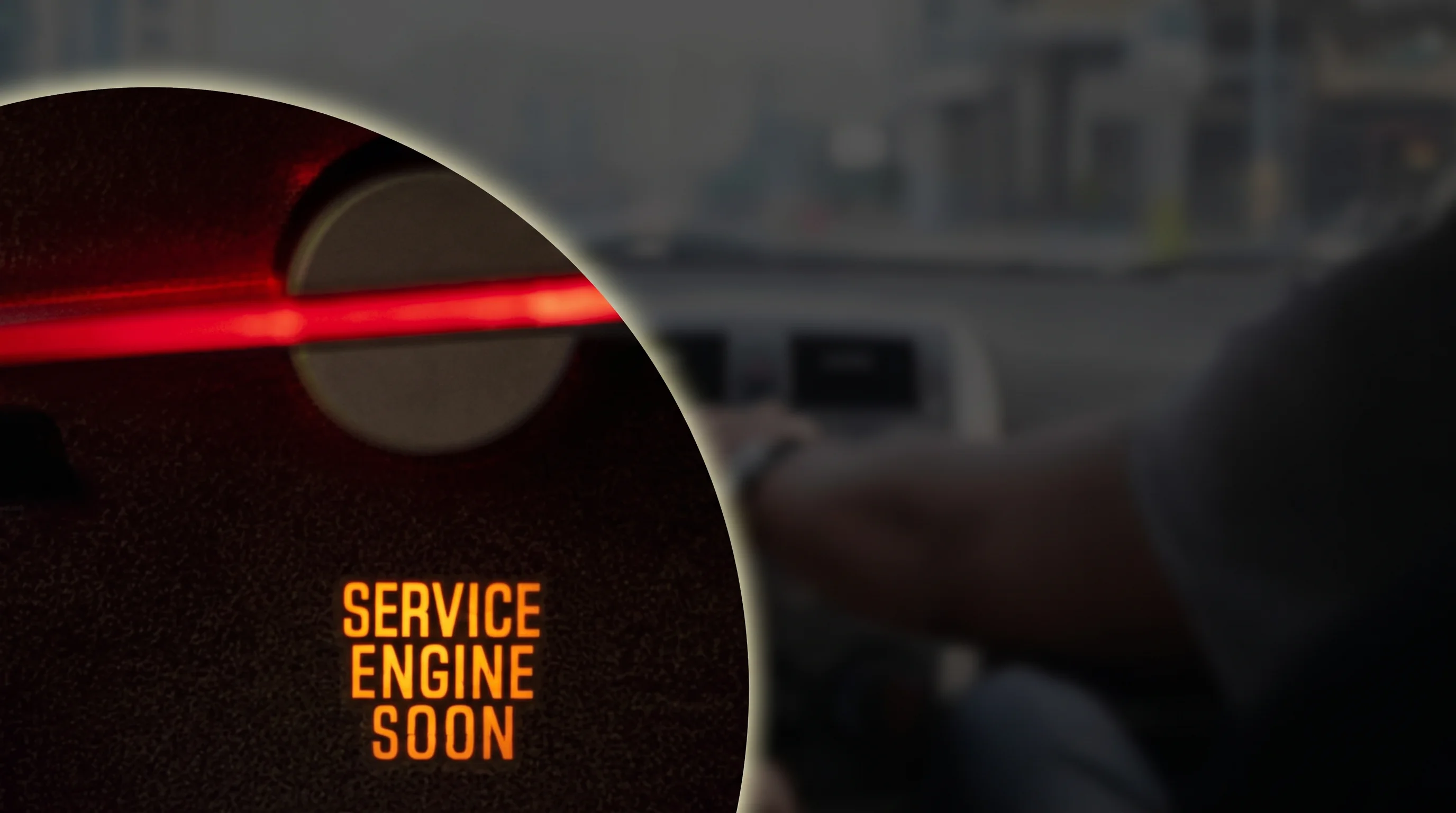
A Service Engine Soon light means your Nissan has found an active fault. It may sit in the engine management, the emissions system, or the sensor network. When a reading falls outside factory limits, the engine control unit stores a trouble code and turns the light on. The cause can be as small as a loose gas cap or as serious as a cylinder misfire. Either way, the fix starts with a diagnostic scan, not a guess at which part to replace.
What the Service Engine Soon Light Is Telling You
The engine module watches data from exhaust sensors, air intake meters, fuel injectors, and ignition coils. It does this constantly. When a reading drifts outside its set threshold, the module stores a trouble code and turns on the light. The alert tells you that one of three things has been compromised: engine performance, fuel efficiency, or tailpipe emissions.
Service Engine Soon and Check Engine Are the Same Light
On most Nissans, “Service Engine Soon” and “Check Engine” are the same malfunction indicator lamp, not two separate systems. The California Air Resources Board describes the OBD-II warning light as one that is typically labeled either way, often alongside an engine symbol. If that distinction is what brought you here, our Service Engine Soon vs. Check Engine Light guide covers it in depth.
Solid or Flashing: How Urgent Is It?
How the light behaves matters more than how it is labeled. Nissan’s own guidance splits it into two cases.
| Key question | Solid light | Flashing light |
|---|---|---|
| What it means | An emission control system malfunction has been detected. | An engine misfire has been detected that may damage the emission control system. |
| Is it safe to drive? | Short trips are generally fine if power delivery, idle, and braking all feel normal. | No. Stop driving. |
| What to do first | Check that the fuel filler cap is not loose or missing, then book a diagnostic within a few days. | Pull over safely, shut the engine off, and arrange transport to a service facility. |
The information in this article is general guidance and does not constitute a specific diagnostic or repair recommendation for any individual vehicle. Repair and maintenance decisions should be made in consultation with a certified technician based on the specific condition of your vehicle.
A solid light is not an emergency, but it is not something to leave alone either. An unresolved fault degrades fuel economy, raises tailpipe emissions, and puts secondary strain on related components.
A flashing light is urgent for one specific reason. Unburned fuel enters the hot exhaust and can overheat the catalytic converter. That turns an ignition problem into a far more expensive repair.
Either way, if the light appears alongside heavy vibration, knocking, or visible exhaust smoke, stop driving immediately.
How to Read a Nissan Diagnostic Trouble Code
This is the step most drivers skip. It is also the one that saves money, because replacing parts without pulling the code first is guesswork.
Pulling the Code, Step by Step
- Locate the OBD-II diagnostic port under the dashboard on the driver’s side. Your owner’s manual shows the exact position for your model.
- Plug the scan tool connector securely into the port.
- Turn the ignition to ON without starting the engine.
- Power on the scanner and select the code-reading or diagnostic scan function.
- Note every active, pending, and historical code the tool displays.
What the Code Actually Tells You
A code identifies the system reporting a fault, not the part that failed. P0420, for example, reports that catalyst system efficiency is below the required threshold on bank one. That points toward the catalytic converter. But the real cause can sit upstream, in a sensor or an ignition component. Codes that begin with P1 are manufacturer-specific rather than shared across every vehicle.
That gap between retrieving a code and identifying a cause is exactly why pin-point testing and component testing matter. A code number is a starting point, not a diagnosis.
The information in this article is general guidance and does not constitute a specific diagnostic or repair recommendation for any individual vehicle. Repair and maintenance decisions should be made in consultation with a certified technician based on the specific condition of your vehicle.
Why Disconnecting the Battery Does Not Fix It
Disconnecting the negative battery cable may clear the light temporarily, but it returns as soon as the computer completes its self-test and finds the unaddressed fault. Clearing a code without repairing the cause only delays the work.
It also creates a second problem. Clearing the on-board memory resets the vehicle’s readiness monitors to incomplete. That happens whenever a battery is disconnected, goes dead, or is replaced. The California Air Resources Board notes that you then have to drive the car normally for about a week before those self-checks finish running.
That matters in California. Under the Bureau of Automotive Repair’s OBD inspection criteria, a 2000-or-newer gasoline vehicle can have only its evaporative system monitor incomplete and still pass a Smog Check. Clearing codes shortly before an inspection is a reliable way to fail one.
Schedule Nissan Diagnostics in Ontario
Before you book anything, try the free check. Pull over, shut off the ignition, open the fuel door, and tighten the gas cap until it clicks. If a loose cap caused an evaporative emission code, the light may switch off on its own after a few normal driving trips. The system has to confirm a proper seal first.
If the light stays on after that, or if it starts flashing, have the code read. The Empire Nissan service center at 1377 Kettering Dr serves drivers across Ontario, Montclair, Fontana, and Rancho Cucamonga. You get Nissan-trained technicians and genuine OEM Nissan parts. Call the service desk at (909) 740-6715 or book your appointment online.
Frequently Asked Questions
What are the most common triggers for a Nissan Service Engine Soon light?
Nissan lists five common causes: a loose or missing fuel filler cap, a faulty oxygen sensor, a mass airflow sensor, worn spark plugs, and a damaged catalytic converter. Running very low on fuel can also bring the light on.
Is it safe to drive with the Service Engine Soon light on?
With a solid light and a vehicle that drives normally, short trips are generally fine. Still, schedule a diagnostic within a few days. A flashing light is not safe to drive on. It signals a misfire that can destroy the catalytic converter.
Will a Service Engine Soon light fail a California Smog Check?
An illuminated light will fail the inspection. The Bureau of Automotive Repair fails any vehicle whose malfunction indicator lamp is on while the engine runs. A stored code on its own does not automatically fail the test. Permanent diagnostic trouble codes on 2010-and-newer vehicles do. Clearing codes beforehand does not help either, because incomplete readiness monitors also fail.
The information in this article is general guidance and does not constitute a specific diagnostic or repair recommendation for any individual vehicle. Repair and maintenance decisions should be made in consultation with a certified technician based on the specific condition of your vehicle.
Disclaimers
The information in this article is general guidance and does not constitute a specific diagnostic or repair recommendation for any individual vehicle. Repair and maintenance decisions should be made in consultation with a certified technician based on the specific condition of your vehicle.