
Nissan Tire Size Guide By Model
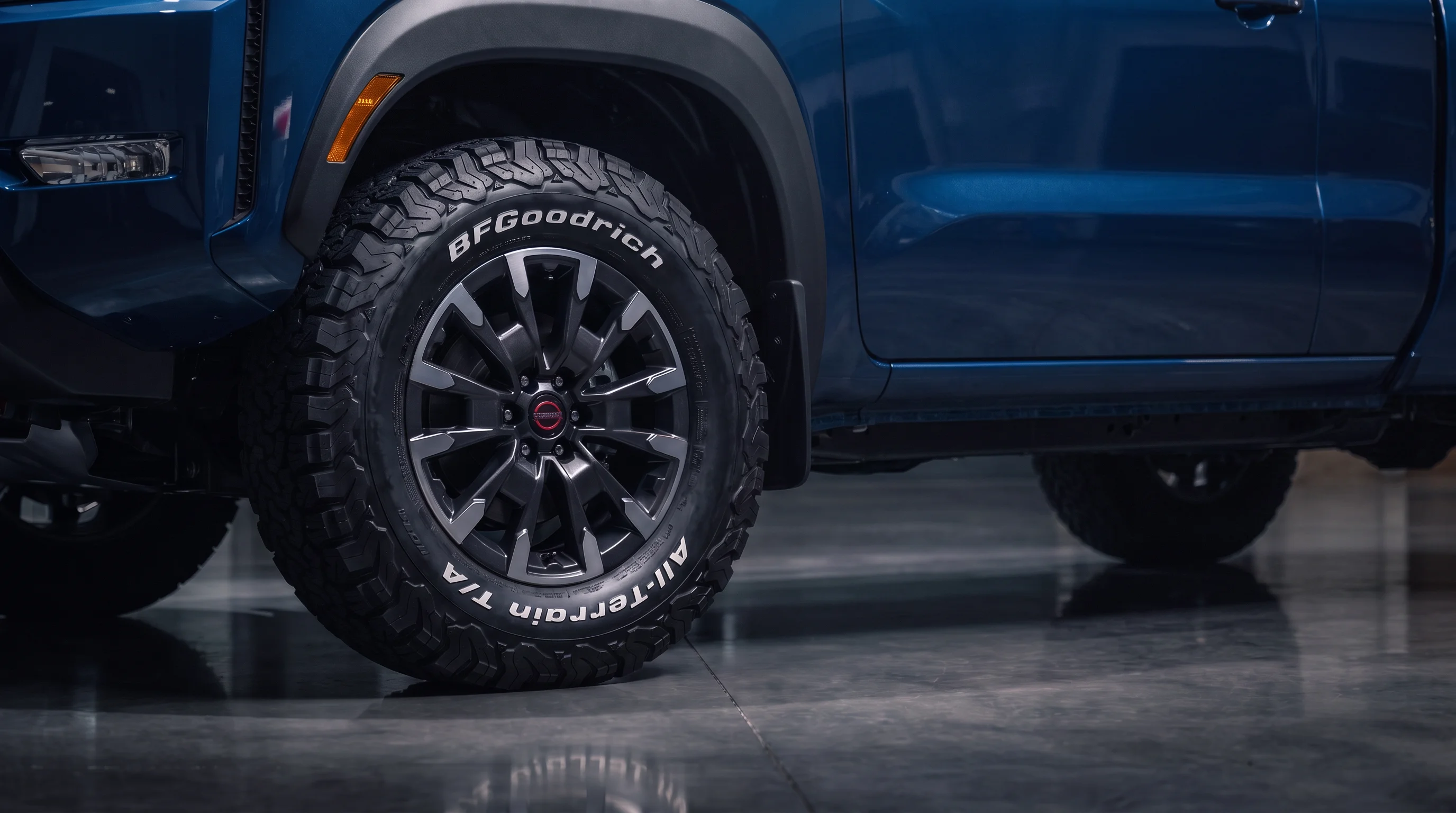
Nissan tire sizes run from 16-inch fitments on the Sentra up to 22-inch fitments on the Armada. What you need depends on your model, your trim, and which wheels came on the vehicle.
This guide lists the factory tire sizes by model and trim, explains how to read the code on your sidewall, and shows you where to find the exact size for your own vehicle. Getting it right matters. The correct size keeps your speedometer honest, keeps the tire’s grip patch the size Nissan designed it to be, and lets the braking and traction systems work the way they were set up to work.
If you want to confirm you have the correct size, our team is here to assist you. You can explore tire service and OEM-recommended tires at Empire Nissan, stop by our showroom on Kettering Drive, or book a tire consultation online. Don’t forget to check out our Service & Parts Specials before you come in.
Nissan Tire Sizes by Model and Trim
These are the factory fitments for the models listed below, checked against Nissan’s published specifications for the Sentra, Altima, Kicks, Rogue, Murano, Pathfinder, Armada, Frontier, LEAF, and Z. Several Nissan models changed wheel packages within the last two generations, so an older vehicle wearing the same badge may take a different size. Use this as a starting point, then confirm on your door jamb placard before you order.
Sedans
| Model | Trim | Tire Size | Wheel |
|---|---|---|---|
| Sentra | S, SV | 205/60R16 | 16-inch |
| Sentra | SL | 215/50R17 | 17-inch |
| Sentra | SR | 215/45R18 | 18-inch |
| Altima | SV | 215/55R17 | 17-inch |
| Altima | SR | 235/40R19 | 19-inch |
Crossovers and SUVs
| Model | Trim | Tire Size | Wheel |
|---|---|---|---|
| Kicks | S | 215/65R16 | 16-inch |
| Kicks | SV | 215/60R17 | 17-inch |
| Kicks | SR | 225/45R19 | 19-inch |
| Rogue | SV | 235/60R18 | 18-inch |
| Rogue | Rock Creek | 235/65R17 all-terrain | 17-inch |
| Rogue | Dark Armor, Platinum | 235/55R19 | 19-inch |
| Murano | SV, SL | 255/55R20 | 20-inch |
| Murano | Platinum | 255/50R21 | 21-inch |
| Pathfinder | SV, SL | 255/60R18 | 18-inch |
| Pathfinder | Rock Creek | 265/60R18 all-terrain | 18-inch |
| Pathfinder | Platinum | 255/50R20 | 20-inch |
| Armada | SV | 265/70R18 | 18-inch |
| Armada | SL | 275/60R20 | 20-inch |
| Armada | Platinum Reserve, NISMO | 275/50R22 | 22-inch |
The Rock Creek grades on the Rogue and Pathfinder come from the factory on all-terrain tires rather than all-season, which is worth knowing when you replace them.
Trucks
| Model | Trim | Tire Size | Wheel |
|---|---|---|---|
| Frontier | S | 265/70R16 | 16-inch |
| Frontier | SV | 265/65R17 | 17-inch |
| Frontier | PRO-X, PRO-4X | 265/70R17 | 17-inch |
Dark Armor on the Frontier is a package rather than its own grade, so its tire size follows whichever trim it is fitted to.
Electric and Sports Cars
| Model | Trim | Tire Size | Wheel |
|---|---|---|---|
| LEAF | S+, SV+ | 215/55R18 | 18-inch |
| LEAF | Platinum+ | 235/45R19 | 19-inch |
| Z | Sport | 245/45R18 front and rear | 18-inch |
| Z | Performance | 255/40R19 front, 275/35R19 rear | 19-inch |
| Z | NISMO | 255/40R19 front, 285/35R19 rear | 19-inch |
The Z Performance and NISMO run a staggered setup, meaning the rear tires are wider than the fronts. That changes how the car can be rotated, which is covered further down.
How to Read a Nissan Tire Size
The size is molded into the sidewall as a short code, something like P215/65R16 95H. Each part of it means something specific.
What Each Part of the Code Means
| Part of the Code | In “P215/65R16 95H” | What It Means |
|---|---|---|
| Tire type | P | “P” is a passenger tire, made for cars, crossovers, and lighter SUVs. “LT” is a light truck tire, built for heavier loads and higher air pressure. |
| Width | 215 | How wide the tire is in millimeters, measured across the tread. |
| Sidewall height | 65 | Sidewall height as a percentage of the width. Here that is 65 percent of 215 mm, or about 140 mm. A lower number means a shorter, stiffer sidewall and sharper steering. A higher number means a taller sidewall and a softer ride. |
| Construction | R | Radial, which is how nearly every modern passenger tire is built. |
| Wheel size | 16 | Wheel diameter in inches. A 16-inch tire only fits a 16-inch wheel. |
| Load index | 95 | How much weight one tire can carry. Cars usually fall between 84 and 95. Trucks and large SUVs run higher. |
| Speed rating | H | The top speed the tire is rated for. H is 130 mph and W is 168 mph. |
The National Highway Traffic Safety Administration’s TireWise resource covers tire labeling, grading, and what each marking on the sidewall is telling you.
If you are looking at a used vehicle, it is worth checking that the sidewall code matches what the placard calls for. It tells you whether a previous owner put the right load rating on it.
Where to Find Your Exact Tire Size
There are three places to look, and they do not all tell you the same thing.
Three Places to Look
| Where | What It Tells You | Use It for Air Pressure? |
|---|---|---|
| Driver-side door jamb placard | Factory tire size front and rear, wheel size, spare size, weight limits, and the recommended cold inflation pressure. | Yes. This is the one to follow. |
| Owner’s manual | The same sizes, plus optional wheel packages, load limits, and seasonal tire notes. | Yes, it repeats the placard figure. |
| Tire sidewall | The size of the tire currently on the vehicle, and that tire’s maximum pressure. | No. The sidewall number is a maximum, not a recommendation. |
That last distinction catches a lot of people. The National Highway Traffic Safety Administration is clear that the recommended cold inflation pressure comes from the vehicle’s tire information placard, not from the sidewall.
What Happens If You Use the Wrong Size
The 3 Percent Guideline
A different size changes how far the tire travels in one full turn. Your speedometer, odometer, anti-lock brakes, traction control, and driver-assist features are all calibrated around that number. The National Highway Traffic Safety Administration advises buying replacement tires in the same size as the vehicle’s original tires, or another size recommended by the vehicle manufacturer. When a different size is being considered, the widely used industry guideline is to stay within 3 percent of the original overall diameter. Past that, things start to drift.
What Changes
| What Is Affected | Why | What You Might Notice |
|---|---|---|
| Safety systems | Traction control and blind-spot systems read wheel rotation speed. | Brake pulsing in normal corners, or stability control stepping in late. |
| Clearance | A wider or taller tire has less room to move. | Rubbing against fender liners or suspension parts over bumps or at full steering lock. |
| Steering feel | Changing width or wheel offset changes the steering geometry. | The vehicle wanders, or the front tires wear unevenly. |
| Acceleration and estimated fuel economy | Bigger tires are heavier and take more effort to spin up. | Slower off the line, and estimated fuel economy can drop. |
EPA-estimated fuel economy figures are for comparison purposes only. Your actual mileage will vary depending on driving conditions, how you drive and maintain your vehicle, battery age/condition, and other factors.
What Tire Size Means for Replacement Cost
Bigger wheels cost more to re-shoe. Smaller wheels with taller sidewalls use common sizes and simpler construction, so they stay cheaper. Here is what actually drives the number.
What Drives the Price
| Factor | Effect on Cost |
|---|---|
| Wheel diameter | 16- and 17-inch tires use high-volume sizes and cost the least. 19-, 20-, and 22-inch tires cost more per tire. |
| Speed rating | W-rated tires on larger wheels use grippier rubber that wears faster, so you replace them sooner. |
| Load rating | Truck and large SUV tires carry extra layers of reinforcement, which raises the price. |
If you are choosing between trims and you drive a lot around Ontario, Montclair, or Fontana, a 17- or 18-inch package usually costs you less over the years you own the vehicle.
Tire Rotation Patterns for a Nissan
Front-Wheel Drive: the Forward Cross
On a front-wheel drive Nissan, the front tires steer, put the power down, and do most of the braking all at once. They wear noticeably faster than the rears. The Forward Cross pattern evens that out: the fronts move straight back on the same side, and the rears cross over to the opposite front corners.
Rotation Patterns by Setup
| Setup | Pattern | How the Tires Move |
|---|---|---|
| Front-wheel drive | Forward Cross | Fronts go straight back. Rears cross to the opposite front corners. |
| All-wheel drive | Rearward Cross or X-Pattern | Rears go straight forward. Fronts cross to the opposite rear corners. |
| Directional tread | Front to Rear | Same side only. The tire stays on its side of the vehicle. |
| Staggered sizes | Side to Side | Left and right swap on the same axle, and only if the tires are non-directional. Front to rear is not an option when the sizes differ, and some vehicles cannot be rotated at all. |
How Often to Rotate
The National Highway Traffic Safety Administration advises rotating every 5,000 to 8,000 miles where the vehicle manufacturer recommends rotation, or sooner if uneven wear shows up. Pinning it to an oil change makes it easy to remember. All-wheel drive models are worth staying on top of. When tread depths drift apart between the front and rear axles, the transfer case and center coupling end up fighting themselves. Your owner’s manual has the interval and pattern for your specific vehicle.
The information in this article is general guidance and does not constitute a specific diagnostic or repair recommendation for any individual vehicle. Repair and maintenance decisions should be made in consultation with a certified technician based on the specific condition of your vehicle.
DIY or Professional Installer?
Looking up a tire size is easy. Mounting and balancing one is not, and neither is getting the sensors talking to the vehicle again afterward. Here is what a shop visit covers that a driveway job does not.
Balancing
A balancing machine finds the heavy spots in the wheel and tire together and offsets them with small weights. Skip it and you get steering shake at highway speed and early wheel bearing wear.
Centering
The wheel should sit on the hub, not hang on the lug nuts. Get that wrong and the wheel sits slightly off-center, which you feel as a vibration.
TPMS Reset
Passenger cars, light trucks, and vans from the 2008 model year onward are required to have a tire pressure monitoring system under Federal Motor Vehicle Safety Standard No. 138, and some 2006 and 2007 vehicles have one as well. New seals, new valve cores, and an electronic relearn keep it reporting correctly to your dash.
Alignment Check
New tires on a vehicle that is out of alignment can be ruined in a few thousand miles. A quick check of camber, caster, and toe protects the set you just paid for.
Our service team can confirm the right fitment for your vehicle and handle the mounting, balancing, and sensor work. You can also read more Nissan service and parts tips before you come in.
Frequently Asked Questions
Do higher Nissan trims always come with bigger wheels and tires?
Usually, yes. Base trims tend to run 16- or 17-inch wheels with taller sidewalls, and higher trims step up to 18-, 19-, 20-, or 22-inch wheels with shorter sidewalls. Bigger wheels look sharper and turn in quicker. Smaller ones ride better and cost less to replace.
How often should all-wheel-drive Nissan models be rotated?
Every 5,000 to 8,000 miles, and lining it up with your oil changes is the easiest way to stay on schedule. Even tread depth matters more on all-wheel drive, because a gap between the front and rear axles puts constant strain on the transfer case and center coupling. Rearward Cross is the usual pattern, with X-Pattern as an alternative, unless directional tires are fitted. Check your owner’s manual for what Nissan specifies for your vehicle.
Can I run winter tires in a different size than my summer tires?
Yes. Dropping a wheel size and going to a taller sidewall for winter, sometimes called minus-sizing, is common practice and helps absorb potholes. The one rule of thumb is that the overall diameter should stay within 3 percent of factory, so the speedometer and safety systems stay accurate.
What tire sizes does the Nissan Sentra use?
The current Sentra runs 205/60R16 on the S and SV, 215/50R17 on the SL, and 215/45R18 on the SR. The 16-inch setup rides the most comfortably, and the 18-inch setup on the SR grips harder and steers quicker.
What tire sizes does the Nissan Kicks use?
The current Kicks runs 215/65R16 on the S, 215/60R17 on the SV, and 225/45R19 on the SR. Check your door jamb placard to confirm, since wheel packages can vary by build.
Schedule Your Nissan Tire Service
The right tire size protects the ride, handling, and efficiency your Nissan was built around. Whether you drive an Altima, a Rogue, or a Frontier, matching the factory load rating, speed rating, and air pressure is what keeps the vehicle predictable.
Our team at Empire Nissan handles mounting, balancing, and alignment, and can confirm the exact fitment for your model and trim. Book online or call the service department and we will match you to the right specification.