
2026 Nissan LEAF MPGe and Range: Efficiency Guide for Ontario Drivers
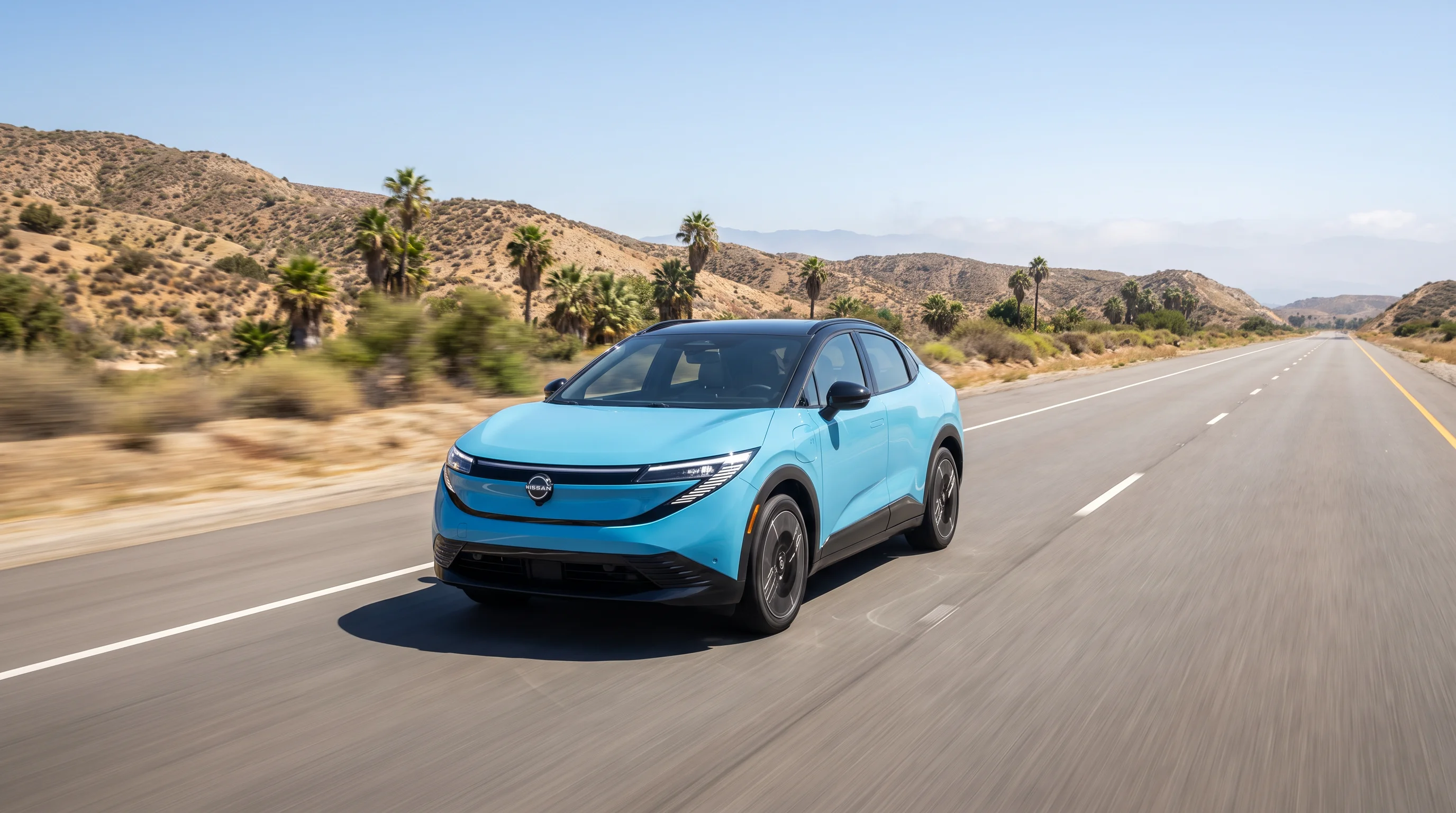
What Is the EPA-Estimated Electric Driving Range of the 2026 Nissan LEAF?
The 2026 Nissan LEAF travels up to 303 miles on a full charge. That EPA-estimated figure belongs to the S+ trim and its 75-kWh battery. The SV+ is rated at 288 miles, and the Platinum+ at 259 miles, according to Nissan. In the Edmunds EV Range Test, a LEAF Platinum+ traveled 310 miles, comfortably past its 259-mile EPA estimate.
This tiered structure lets shoppers match an EV to how they actually drive. The entry-level S+ starts at $31,535 MSRP. It squeezes the most from the battery with 18-inch steel wheels and aero covers, earning an EPA-estimated 131 MPGe city and 111 MPGe highway. Commuters crossing the flat Pomona Valley floor through Montclair benefit from the LEAF’s 0.26 drag coefficient, which holds the power draw steady and predictable.
The SV+ at $35,775 MSRP pairs 288 miles of EPA-estimated range with dual 14.3-inch widescreen displays and Google built-in. The Platinum+ costs $40,535 MSRP and delivers 259 miles. It adds 19-inch aluminum-alloy wheels, a dimming panoramic roof, and a 10-speaker Bose Personal Plus audio system. All three share the same 75-kWh liquid-cooled lithium-ion battery. Liquid cooling is a first for the LEAF, and it circulates coolant to hold the cells in their best temperature range.
| Trim | Starting MSRP | EPA-Estimated Range | EPA-Estimated MPGe (Combined) |
|---|---|---|---|
| S+ | $31,535 MSRP | 303 miles | 121 MPGe |
| SV+ | $35,775 MSRP | 288 miles | 114 MPGe |
| Platinum+ | $40,535 MSRP | 259 miles | 103 MPGe |
Manufacturer’s Suggested Retail Price (MSRP) for new vehicles includes manufacturer and distributor options and delivery, process and handling fees, which may be subject to change at any time. MSRP excludes taxes, title, license and dealer installed options, accessories, fees and charges. MSRP is not the dealer advertised price. Dealer price will vary. The dealer sets the final price.
EPA-estimated fuel economy figures are for comparison purposes only. Your actual mileage will vary depending on driving conditions, how you drive and maintain your vehicle, battery age/condition, and other factors.
A closer look at what separates each grade is available in our breakdown of the 2026 Nissan LEAF trim levels.
What Are the Level 1 and Level 2 Charging Times for the 2026 Nissan LEAF?
Nissan lists a full charge on a 240-volt Level 2 home charger at approximately 6.5 hours for the 75-kWh battery. Standard 120-volt Level 1 charging from a household outlet works for smaller top-ups. For daily commuters, a dedicated Level 2 wall box is the practical choice. It refills the pack overnight, during off-peak utility hours. A portable charge cable is included with the vehicle.
The 2026 LEAF uses two charging ports rather than one. A J1772 port on the driver’s-side fender handles Level 1 and Level 2 AC charging at home and at most public stations. A built-in North American Charging Standard (NACS) port on the passenger side handles DC fast charging. That opens up more than 20,000 Tesla Superchargers, with no separate adapter needed.
| Charging Method | Port | What to Expect |
|---|---|---|
| Level 2 home charging (240V) | J1772 | Approximately 6.5 hours for a full charge |
| DC fast charging (Level 3) | NACS | 10% to 80% in about 35 minutes at up to 150 kW |
How far this generation has come is clearest side by side with the outgoing car, in our 2026 LEAF versus the 2025 LEAF comparison.
How Do Highway Speeds, Weather, and Driving Modes Affect Real-World LEAF Range?
Why speed matters more than heat
Speed, not temperature, is the dominant variable in Southern California. Aerodynamic drag rises with the square of road speed. Each additional mph above roughly 50 costs disproportionately more energy. Telematics analysis of more than three million EV trips put numbers on it. Electric sedans gave up roughly 18% of their range going from 50 mph to 70 mph. At 80 mph, the loss reached about 28%.
Our mild regional climate spares LEAF owners the severe cold-weather losses drivers face elsewhere. Summer air conditioning does draw power. But the same research found cabin cooling is close to a fixed draw. At freeway speeds, its effect is small next to drag.
Managing energy with Drive Modes and e-Step
Drivers can manage consumption directly. The LEAF offers four selectable Drive Modes. Its e-Step system uses the motor to slow the car when you lift off the accelerator. That recaptures energy normally lost as brake heat. In stop-and-go traffic, e-Step cuts brake-pedal use substantially. It will not bring the car to a complete stop on its own, though, so the brake pedal still does the last of the work. Keeping tires properly inflated also protects the range you paid for.
New to electric driving? Our guide to going EV covers the basics before you shop.
How Can Ontario Buyers Estimate Annual Electricity Costs and MPGe Savings?
Start with your yearly mileage and the LEAF’s energy consumption rate. Then apply your utility’s residential kilowatt-hour rate. For a 15,000-mile year:
- Divide 15,000 annual miles by 100, which gives 150 units of 100 miles.
- Multiply 150 by the EPA’s rating of 33 kWh per 100 miles, about 4,950 kWh a year.
- Multiply 4,950 kWh by your home electricity rate, for example $0.25 per kWh, for roughly $1,238 a year.
A gasoline vehicle averaging 30 mpg over the same 15,000 miles burns 500 gallons. At $4.50 per gallon, that is $2,250. The difference leaves about $1,000 a year in the driver’s pocket. Real-world consumption can beat the EPA figure, too. Edmunds measured 27.8 kWh per 100 miles in its LEAF testing, which would pull the annual estimate lower still.
EPA-estimated fuel economy figures are for comparison purposes only. Your actual mileage will vary depending on driving conditions, how you drive and maintain your vehicle, battery age/condition, and other factors.
Every trim shares the same front-wheel-drive powertrain and single-speed direct drive. Efficiency differences across the lineup come down to wheels, weight, and equipment rather than propulsion.
| Specification | Every 2026 LEAF Trim |
|---|---|
| Horsepower | 214 hp |
| Torque | 261 lb-ft |
| Battery | 75 kWh liquid-cooled lithium-ion |
| Transmission | Single-speed direct drive |
| Drivetrain | Front-wheel drive |
What EV ownership actually looks like day to day is covered in our EV ownership experience overview, and the full electric lineup is available to browse.
Common Questions About 2026 Nissan LEAF Battery Durability and Daily Efficiency
How durable is the 75-kWh battery in hot Southern California conditions?
The 2026 LEAF uses a liquid-cooled thermal management system engineered to hold battery temperature stable through hot summer days. Unlike the air-cooled packs of earlier LEAF generations, this system actively circulates coolant through the pack to protect cell chemistry during rapid charging and sustained freeway driving. Nissan backs the pack with an 8-year/100,000-mile limited battery warranty.
Does carrying extra passengers or cargo reduce electric range?
Extra payload increases vehicle mass, and additional mass requires additional energy under acceleration, so a fully loaded LEAF will return somewhat less range than an empty one. With 20 cubic feet of cargo volume behind the rear seats, the LEAF handles daily gear, groceries, and luggage without the kind of loading that meaningfully changes a commute.
How does e-Step help maximize efficiency in city driving?
Lifting off the accelerator engages the motor to slow the vehicle, converting momentum that would otherwise leave the car as brake heat back into stored electricity. In heavy stop-and-go suburban traffic that recovery adds up, and it reduces wear on brake pads and rotors along the way. e-Step does not fully replace the brake pedal, and bringing the LEAF to a complete stop still requires it.
Driver-assistance and advanced safety systems are supplemental aids and are not substitutes for safe and attentive driving. Availability, operation, and effectiveness vary by trim and equipment and depend on factors including road, weather, traffic, and vehicle condition. Always keep your hands on the wheel and your eyes on the road. See your owner’s manual for system limitations and details.
What does the built-in NACS port do for longer trips?
The integrated North American Charging Standard port gives 2026 LEAF owners direct access to more than 20,000 Tesla Superchargers across North America with no third-party adapter. Plugging straight into a Level 3 fast charger takes the battery from 10% to 80% in roughly 35 minutes, which fits a regional trip around a meal stop rather than building the trip around the charger.
What routine maintenance keeps the LEAF operating efficiently?
Electric vehicles eliminate oil changes, spark plugs, and timing belt service, but basic upkeep still protects range. Checking tire pressures regularly, maintaining proper wheel alignment, and replacing cabin air filters on schedule keep rolling resistance low and the cabin systems working as designed.
Explore the 2026 Nissan LEAF Range and Features
The fastest way to pick a trim is to feel the LEAF’s 214 horsepower and instant 261 lb-ft of torque for yourself. The choice runs from the ultra-efficient S+ at 303 miles of EPA-estimated range, to the well-equipped SV+ at 288 miles, to the Platinum+ at 259 miles. ProPILOT Assist comes standard on all three.
Visit us in Ontario to compare trims side by side. Drive the LEAF on local roads to feel how e-Step behaves in traffic. We can walk through home charging before you commit. You can find us at 1377 Kettering Dr, Ontario, CA 91761, or reach our sales team at 909-740-6712.
Disclaimers
Manufacturer’s Suggested Retail Price (MSRP) for new vehicles includes manufacturer and distributor options and delivery, process and handling fees, which may be subject to change at any time. MSRP excludes taxes, title, license and dealer installed options, accessories, fees and charges. MSRP is not the dealer advertised price. Dealer price will vary. The dealer sets the final price.
EPA-estimated fuel economy figures are for comparison purposes only. Your actual mileage will vary depending on driving conditions, how you drive and maintain your vehicle, battery age/condition, and other factors.
Driver-assistance and advanced safety systems are supplemental aids and are not substitutes for safe and attentive driving. Availability, operation, and effectiveness vary by trim and equipment and depend on factors including road, weather, traffic, and vehicle condition. Always keep your hands on the wheel and your eyes on the road. See your owner’s manual for system limitations and details.